Sunday, July 26, 2015

Sow Where You Don't Reap; Reap Where You Don't Sow--George's Post


A.   Sow Where You Don’t Reap; Reap Where You Don’t Sow—Long Line of Senior Missionaries


On occasion, when I fall prey to being discouraged, Carole reminds me that we are only one in a long chain of Mormon senior missionaries who will labor in Malawi.  Mormon senior missionaries served before us, and they will come after we leave.  The efforts of all them, taken together, are intended to help establish the Mormon Church in Malawi, to relieve suffering, and to bring joy to the poor and those in need of comfort. The names of other senior couples crop up from time to time.  To name but a few—the Reynolds, Merrills, Bullocks, Pretes, Fisks, Stones, Birrells, Binghams, Bodilys and Ericksons.   When compared to senior missionaries, mission presidents tend, as one might expect, to leave more of a mark on the faithfulness of the local members, owing to their spiritual maturity and platform.  Yet small reminders of the service given by those senior missionaries can be found littered in the office files in the Mormon Church’s long-time residence on One Kufa Road in Blantyre--their spiral binders, temporary employment permits, random photos, an album of missionary pictures, letters to the Malawi Department of Immigration.  From time to time, when we visit with members, they will share with us stories about something an earlier missionary couple may have done or said.  But these fragmentary records are bad history, no more reflective of the rich and active lives they led in Malawi, or the impact they had upon members, than official government records of births, marriages and deaths are of capturing the largely undocumented lives of our ancestors. 
Most significantly the contributions of these earlier Mormon missionaries are reflected in part in the lives of Malawi’s existing members—their testimonies, commitment to the gospel, payment of tithes and offerings, becoming and staying self-reliant, and service as full-time missionaries--going to Kenya, Ethiopia, Tanzania, Uganda, Zimbabwe, Botswana, South Africa, Ghana--the thousands of sacrifices they make to be members of the Mormon Church.  This is not new, but instead is the history of the Christian Church from the time of the Savior and his earliest disciplines, including the great missionary Paul.    “Do we begin again to commend ourselves? Or need we, as some others, epistles of commendation to you, or letters of commendation from you?  Ye are our epistle written in our hearts, known and read of all men:  Forasmuch as ye are manifestly declared to be the epistle of Christ ministered by us, written not with ink, but with the Spirit of the living God; not in tables of stone, but in fleshy tables of the heart.”  2 Cor. 3:1-3.  Paul understood that the greatest legacy he could leave was to pass along to new members a fervent testimony of the gospel—something engraven in their hearts.
Yet, in the end, missionaries’ contributions pass largely unseen and remain anonymous.  Senior couples hope they have an impact, but are never quite sure if they have done much good.  Rarely do they see the fruits of their labors.  They may work to reactivate a family, but are never sure whether their efforts will meet with much long-term success.  The less active family may start back to church, but will the gospel stick and will they have the resilience to come on their own without constant encouragement from the missionaries.  Senior missionaries may teach primary or lead music during sharing time and never know what is going on in the minds of the young boys and girls.  All they see is young ones listening to primary stories and starting to get excited about singing primary songs and joining in the sharing time games.  While they hope to have spoken to the spirits of the youth, they are uncertain whether the primary kids will go on missions, marry in the church, and raise righteous family, creating multigenerational families steeped in the gospel and rooted in faithfulness.  What gives the senior missionaries hope are the examples of those more seasoned in the Mormon Church—the leaders and faithful adult members who have gone on missions, returned home to establish families in the gospel, and have seasoned testimonies.  Somehow and someway they were able, with the help of earlier missionaries and faithful members, to get testimonies and move through the conversion process.  If it was done successful before, surely it can be done successfully again.
But senior missionaries, despite their hopes, find it impossible to see through the years and to know how they may have touched the life of a young man or woman, or how that influence may be distinguished for the influence of others.  If they do influence someone for good, the fruits of that influence may not come for months and years after they leave to go back home. 
For the most part, our influence upon others is reflected in small and seemingly insignificant acts.  It merges seamlessly with the influences of others and, together with the influence of others, forms cycles of support, comfort, and leadership that slowly helps local members stay connected to the Mormon Church.  “Say not ye, There are yet four months, and then cometh harvest?  Behold, I say unto you, Lift up your eyes, and look on the fields; for they are white already to harvest.  And he that reapeth receiveth wages, and gathereth fruit unto life eternal:  that both he that soweth and he that reapeth may rejoice together.  And herein is that saying true, One soweth, and another reapeth.  I sent you to reap that whereon ye bestowed no labour:  other men labored, and ye are entered into their labours.”  John 4:35-38.  Moreover, each senior couple knows that its efforts get unevenly spread—a few individuals and families are known well, but most of one’s efforts are spread pretty thin.  One must be content with occasional visits, greetings in church, small acts of kindness—nothing akin to the intense training or spiritual guidance one envisions as being necessary to change lives.  The younger elders and sisters are close to that experience as they proselyte and teach the basic lesson of the restoration.
In saying this, we need to be careful not to underestimate the impact we may have upon others—even in routine settings--and of the occasional bursts of the spirit to which senior missionaries are entitled.  By way of example, most of the senior couples we have met in Malawi would be surprised by the impact they have had upon Carole and me.  We have had very little contact with them, each of us being busy with our own assignments.  And yet, despite this, each has touched our hearts in little but significant ways and, if that has happened, it is not unreasonable to imagine that we in turn have had more influence on others than we might otherwise suspect.  We will likely have influenced them for better or worse, despite the limited nature of our contacts and even though we have largely been oblivious to the potential impacts.  Carole and I were astounded by the Reynolds’ good nature and unflappability.  Elder Reynolds was willing to tackle any task to improve the quality of the local missionaries’ life, even at the expense of his own comfort.  Late nights, early morning hours were par for the course, and never a harsh word and complaint.   The Merrills, then serving their seventh mission in the last 12 years, we considered to be legends on their own right—setting an unparalleled standard of commitment and steadiness.  We were in awe of their faithfulness, knowing we could never come close to matching their peerless self-sacrifice.  The Fisks were steady, committed, and direct—early on they provided invaluable advice to us on what it meant to be “MLS” missionaries.  We found them, as well as the Stones (both working in Lilongwe) to be far more strategic in their service than we have ever been.  It is one thing to do missionary work, and quite another to do missionary work in a smart way.  The Fisks and Stones each worked on a broader canvass than Carole and I.  They focused their efforts on district-wide training, getting new missionaries ready to go, and helping returned missionaries get back integrated into normal life.  Each of those initiatives were more focused, strategic, and had a greater potential for good than anything we have tackled.  In contrast, Carole and I have worked at a micro level—spending virtually all of our member time making home visits, getting to know our members, being friends, and, if we provided training, the training was mainly incidental.    (The primary exception is Carole’s tireless efforts to help jump start the primary programs in Zingwangwa and Blantyre Second.)  The Birrells have picked up the office couple functions in Lilongwe, and Elder Birrell is anxious to put to use his medical training by volunteering twice a week at a local hospital.  Even those couples who come in and out of Malawi, having assignments both here and elsewhere—the Skidmores, Binghams, Bodilys—have left a mark of faithful service and dedication.  President and Sister Erickson are wonderful with the younger full-time missionaries, good examples, sensitive to their needs, resourceful, wise leaders, and inspirational speakers. 
As I think of our service, I know we need to be content with our lot in life—it should be enough knowing that we build upon the foundation that others have laid, and that others will come after us who may reap what we have partially sown.  Doing good, whatever the results, should be rewarding enough.  Worrying about more than that borders on unrighteous vanity.

Thursday, July 23, 2015

Tomicah's Visit to Malawi--Photos--George's Post


The following are photos from Tomicah's stay with us in Malawi.  Carole and I debated whether we should go to a game park with Tomicah, largely on the grounds that such an excursion bore no resemblance to our actual experience here as missionaries.  In the end, we reached a compromise--we would do a short trip.  It was a fun diversion for us, and hopefully interesting for Tomicah.  But Tomicah was a good sport and allowed us to drag him around most of the townships where the members of the Zingwangwa and Blantyre Second Branches live. 


A close up shot of the stash of candies and other treats Sarah assembled for her parents.
 

Carole is excited to get a bag of jelly-bellies and chocolate chips.

Tomicah was concerned about getting the two suitcases with goodies through customs, not knowing what the custom agents were apt to think or what they might extract as concessions--perhaps demanding a few of my Jordan almonds.  In the end, customs chose to search the one suitcase with clothes and laundry.


For us, it was like Christmas.

The first afternoon we headed up Mount Soche to visit with the Bandas.  This was the beginning of Tomicah's introduction to his celebrity status as an "azungu."  Kids assaulted him everywhere with their favorite chants and English phrases.  "How are you?"  "I am fine"  "Azungu, azungu"

Just below the Bandas' home on Mount Soche.

Once familiar with the camera, kids--like kids everywhere--love to have their pictures taken.

It was twilight by the time we started down from Mount Soche.  Carole was a little worried about blundering around the top of the mountain in the dark, so we choose to forego taking Tomicah up to find Brother Sangala--one of our sweetest members.


Tomicah the photographer.  He has a wonderful camera, a recent birthday present and an ideal gift for someone headed to Africa.

h
Liwonde National Park, straddling the Shirer River, is noted for its large herds of hippos, elephants and crocs.  These fellows were enjoyed an indolent morning nap.

Justin was our guide--for the land rover safari drive (including night drive), early morning walk, and mid-morning boat cruise.

Elephants in the wild are really quite majestic.  They have no natural predators in the park, so the herd is growing rapidly, so much so that the Malawi games department plans to relocate some 300 elephants to other parks sometime in the near future.

As I recall, this was the leaf of a butterfly tree.


Tomicah on our morning hike.  We all thought Eli, Thomas and Lincoln (perhaps even Mim) would have loved the adventure.  Indeed, all of our grandchildren would have had a good time. 

Your guess--elephants' or hippos'.  It was amazing how much data the guide could extract by examining the dung.


A hippo's skeleton.

A candelabra tree.


Amazing prehistoric animals. 


This is a shutter speed problem.  The intent was to get the photo taken while they were facing me.  No such luck.


His Excellency Professor Arthur Peter Mutharika is the current president of Malawi.  He taught law in the United States for some 30 years after getting a masters in law from Yale Law School.  While opinions understandably differ, some have been disappointed, hoping he would be more progressive.  Malawi has suffered from a number of nasty financial scandals, with high ranking officials stealing millions from the government's coffers.

On the way back to Blantyre, we stopped to buy a couple of mice skewers from kids hawking them along the main road.

Christopher Sitolo lives in the quarters behind our residence.  He is from the Ngoni tribe, originally from South Africa.  While you may have thought the mice skewers were for Carole or Tomicah, they actually were for Christopher.  They are still considered tasty and a good source of protein.  Christopher, here in a chef's uniform, is attending the Malawi School of Tourism.  He expects to intern at a 5-star hotel in Lilongwe this summer (summer in Malawi time), and there is a fair possibility that he will be selected in a year or so to go to Vienna for a special tourism course.  He is a returned missionary from the Zimbabwe Harare Mission, the first counselor in the Blantyre Second Branch Presidency, and a good friend.

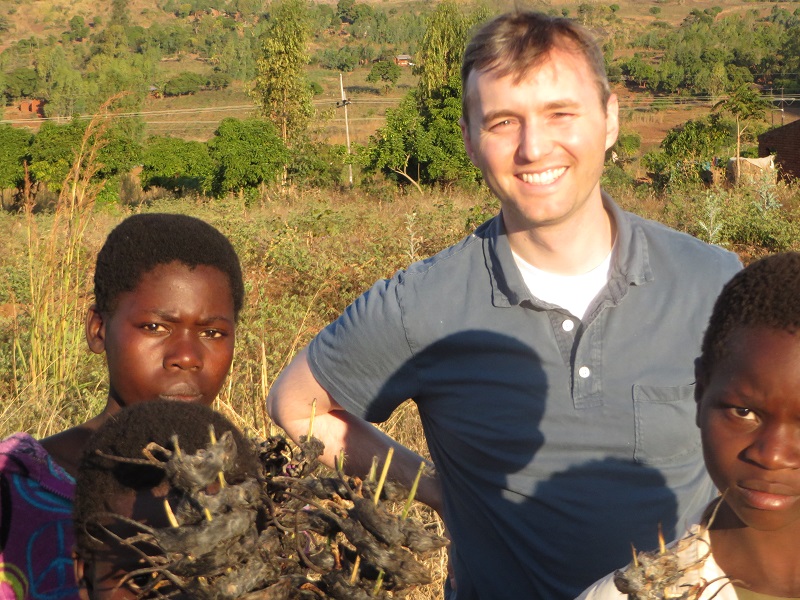
Tomicah is going native, carrying this bundle up the steep hill to the Chikapas' new home.

o
 

Carole and Tomicah just below the Mwale's home.  Sister Mwale is a wonderful member, the wife of the First Counselor in the District Presidency, and an active member of the Public Affairs Committee.  She is a natural--friendly, outgoing, and positive--and always has a smile.


Brother Tsegula and Tomicah, inspecting the crops and fields around the Tsegula family compound, near the Three Ways Market.


At the main Blantyre market, within walking distance of our residence.


Getting Perspective--Visits from Family and Friends--George's Post


A.   Getting Perspective--Visits from Family and Friends

Senior missionaries are permitted to have family and friends visit them in the mission field.  This privilege is not generally extended to the younger elders and sisters.  Perhaps the thinking behind the policy difference is that senior missionaries are more mature, set in their ways, and less likely to become distracted or home sick than the younger missionaries.  Another possibility is the Mormon Church recognizes that such a concession is simply needed to induce more seniors to apply for and accept mission calls.  In like fashion, there are no limitations on the number or nature of the communications that senior missionaries can have with their family.  They are free to email, call or skype family and friends whenever they wish.  In contrast the younger missionaries are limited to two family calls per year (one at Christmas and the other on Mother’s Day), and to emailing their family and friends once a week, for an hour or so, on their preparation days.[1]  But whatever the reasons, the policy difference allows senior missionaries to stay more connected to family and home while away from home.  This is a great blessing to their children and families, who have the opportunity to experience, vicariously through their parents, the life of a missionary.  Carole and I have been pleasantly surprised by the level of interest shown by our grandchildren in our African adventure.  Even the very young understand that we are in Africa, across the ocean, far away from their homes.  Who knows what kinds of images that conjures up in their little minds, likely pictures with exotic animals, birds, thatched roofed huts, small villages, great plains, medicine men, and warriors.  Oddly enough, some of those images are not too far off the mark.
Our first visitor to Malawi, close to nine months into our mission, was Tomicah Tillemann, our daughter Sarah’s husband, and father to five of our grandchildren.  Tomicah has been a great addition to our family, and I was a bit surprised to be reminded that he has been part of the clan for over 12 years.  Tomicah attended a UN sponsored conference (held about once every 8 years) focusing on financing projects in developing countries, held this time in Addis Abeba, Ethiopia, and he was able, after the conference, to tack on a side trip to Malawi before returning to Washington, D.C.  Fortuantely, Ethiopian Air has a fairly convenient flight from Ethiopia to Blantyre.[2]  Being with him for the better part of five days was rejuvenating for us and also served as an opportunity to get a new perspective on our experience in Malawi.  By mere coincidence, Tomicah was the first family member with whom we visited during 2013, our year in Paris.  In the early winter of 2013, he had meetings in Budapest and that was all the excuse Carole and I needed to catch a cheap Ryan Air flight from Paris to Budapest, allowing us to visit Hungary with someone who really knew the lay of the land.  Tomicah’s maternal grandparents were both from Budapest, his grandmother, together with part of the family, escaped Hungary just at the beginning of the Nazi occupation, while his grandfather survived several years of the Nazi occupation before emigrating to Canada and later to the United States.  Apart from this family tie, Tomicah and two of his siblings have served Mormon missions in Hungary. 
We could not help but be intrigued by the stark differences between our short stay in Budapest and Tomicah’s equally short sojourn with us in Blantyre.  When in Budapest with Tomicah, we had a private tour of the Hungarian Parliament Buildings, spent an evening at the Hungarian Opera, toured the world famous Budapest baths, and had an early Sunday morning private audience with the US ambassador to Hungary.  We were hosted by long-time family friends of the Tillemann family, whose ties with the family go back to Annette’s (Tomicah’s mother) childhood summer excursions to the fashionable Balaton Lake in Hungary, spending a lovely afternoon in their apartment flat in a Budapest suburban, and later enjoying their company over a wonderful dinner at a traditional Hungarian restaurant.  Tomicah’s visit in Malawi offered a radically different experience.  The cultural sites of the Parliament Buildings and the royal palace were replaced by a quick 24 hour trip to the Liwonde National Park, one of the seven national parks in Malawi-- with its impressive herds of hippos and elephants, coupled with flotillas of indolent crocodiles; the clusters of local grazers—warthogs, impalas, water bucks and kudus; and the rare sighting of some of the more reclusive animals--mongooses, porcupines, and skunks.  The Hungarian restaurants, opera house, bathhouses, elegant neighborhoods would give way to the colorful African markets, neighborhood vegetable stands, offroad stands offering sugarcane and mice, crowded, active townships, kids chanting “azungus,” adults nodding and returning our greetings, and an arid climb up into the modest neighborhoods of red brick homes high up on the flanks of Mount Soche.  In lieu of visiting with life long Hungarian friends or the US ambassador, Tomicah was exposed to our “new” church friends: a tour of the Chikapa’s newly finished home in Chimakunda; a visit to the Tsegula’s family compound; quick greetings with the Phiris, Malungas, Tchongwes, Lucy Tembo, Lyford Ngwira, the Bandas, Annie Tella, Brother Sangala, Sister Mwale, Brother Muntheli.  The day ended with a visit to the home of Brother and Sister Ngwira, new members, living in Kampala.  Sister Ngwira is an attorney and also works with an NGO, which focuses among other things on protecting prisoner rights, a difficult civil rights issue in a country where little money is available for public services, much less to safeguard the rights of the underprivileged and those on the edge of society.  After a long day on foot, Tomicah, Carole and I came home exhausted, footsore and dusty.
Carole and I have, for several months, been encouraging the District Presidency to schedule regular monthly activities for the young adults to enhance interaction and togetherness among the youth in the District.  Our suggestion was that the District sponsor a fireside one month, then followed by a social—in short, something spiritual, something social.  There is no doubt but what the youth are the key to the Mormon Church’s ultimate growth in Malawi.  While we thought the District Presidency was generally receptive to the idea—at least in some form—as yet nothing has been worked out.   Knowing of Tomicah’s unusual background,[3] we offered Tomicah up as a potential speaker without his counsel or approval, suggesting to President Matale, the second counselor in the District Presidency, that Tomicah might speak at a young adult fireside on the one Sunday he would be with us.  Shortly before Tomicah's arrival we learned that he would be asked to speak, but there really wasn't much time for advance publicity.  Consequently, we sought to dampen Tomicah’s expectations, saying that he should be prepared to speak in front of a small group of five or ten.  Much to our surprise, a crowd of close to fifty turned up, many of them from the Zingwangwa Branch.  Most had come directly from their earlier church meetings, not having had time for lunch or a mid-day break, making their attendance quite amazing.  Tomicah did a marvelous job connecting with the Malawian youth, a daunting task given the relatively limited nature of their exposure to the Western world and its political life. 
Visiting with Tomicah brought the expected benefits—an opportunity to reconnect with family, and to catch up on the family news, without worrying about how good the skype or phone connections might be.[4]   Sarah and the kids now don’t seem quite so far away.  We got reports on how Eli is doing in school, the friends he is making, his improvement on the swim team, getting along with Thomas, incorporating younger brother Lincoln more into their play.  Eli is a master of origami, creating fantastic creations, complex and intricate.  We are all curious as to what Eli will do when he gets older—will his interests in science and dinosaurs continue to burn bright.  Thomas is still Eli’s best bud, fiercely loyal, always up for an adventure; doing great in school, beloved by his teacher, inclusive of others, sensitive to those more in the shadows, a popular classmate.  Like Eli, he is getting more comfortable in the pool, even managing a dive in the deep end, something unthinkable just a few weeks ago.  Lincoln is positive, curious, anxious to be a part of his older brothers’ play, starting to bond with Mim, but usually exhausted by late afternoon.   He can be a handful in the evenings before bed, melt downs often the order of the day, and then he is beyond reason.  Mim continues to run the household, more than holds her own with her brothers; indeed, often her brothers quail in the face of her tantrums and wrath.   She now has the idea with potting training, and is quite proud of herself.  Yet she also has a sweat side, and speaks to her father, as the lone daughter in an otherwise big family of boys often does.  Though still small for her age, she knows just how to preen for the camera.  Fortunately Isaiah is the perfect baby—apart from his teeth, a constant threat to a nursing mother—happy, quick to smile, generally content, even in the face of the family’s commotion.  Sarah marches on, keeping everything together, despite Tomicah’s busy schedule and frequent trips.  This summer the community pool has been a great blessing, entertaining everyone, a great break with D.C.’s hot muggy weather, and even swim team has had its moments—creating a sense of community.
Perhaps one of the unexpected benefits of Tomicah’s trip, especially for Carole, is a break from the routine of being constantly tied at the hip with me.  One of the great advantages of serving as senior missionaries is the opportunity of working side by side with a spouse.  But it is also one of the great challenges of the mission as well.  Especially now that Carole and I are the only senior missionaries left in Blantyre.  When we arrived, we had both Reynolds and Merrills, no more than ten minutes away, to mix things up. 
Tomicah brought with him a carry case, with his laptop and papers, a suitcase for his clothes, together two other large suitcases crammed with Jordan almonds, jelly-bellies, mint paddies, circus peanuts, almond rocha, ballpoint pens, chocolate chips, and cans of crystal light—items not easily found  in Malawi.  Sarah was anxious to assemble for us a care package—and Tomicah was anointed as the mule for transporting the goods.  The mails are unreliable and courier services are expensive and often not much more reliable.  Some of our missionaries, much to their dismay, have waited months for packages from home—Christmas packages arriving in May and June or, in some cases, not showing up at all.  Naturally we loved the treats; the Jordan almonds, one of my favorites, were exhausted in a couple of days.  But more importantly Tomicah brought an inquisitive mind.  He was excited to be in Malawi and curious about everything.  It reminded me of how we felt when first here.  Everything was strange and unfamiliar, and we spent much of our first months trying to figure things out.  The longer we stay, the more comfortable we are—and sometimes, but not always, that means that we start taking things for granted even if we don’t understand them any better.  On occasion, there is a great temptation to be complacent and to stop looking carefully at our experience.


[1] In my experience, non-members are frequently shocked by the apparent harshness of the rules limiting contact with family and friends.  The rules are however in place for good reasons.  The Mormon Church has learned, after having missionaries in the field for close to 200 years, that the single-mindedness required by missionary work is undercut if young missionaries have too much flexibility in communicating with those at home.  Family distractions can prove to be a substantial impediment to doing missionary work.
 
[2] For those outside of Africa, it is easy to forget Africa's scale.  Though Ethiopia is separated from Malawi by just two countries—Kenya and Tanzania—the trip is over 2,500 miles.  Few airlines fly into Blantyre, but as chance would have it, Ethiopia Air is one of them, with a regular flight from Addis Ababa to Blantyre, with only a brief layover in Lilongwe, Malawi’s capital.  It is hard to believe there is enough business between the two countries to warrant regular flights.
[3] Of course, few people in the United States can claim to have worked for both Vice President Biden and former First Lady, former senator, and former Secretary of State Hillary Clinton.  We were unsure about how many of our wonderful local members would know these famous Americans, but were confident Tomicah, given his broad experience and comfort in speaking publicly, could shape a message of general interest to what may have been for him one of his most unusual audiences.
[4][4] Nothing is quite as frustrating as a cranky phone or skype connection, especially after waiting so long to talk to family.  Either you can’t hear them talking, or they you, or the picture frames freeze, leaving your kids or grandchildren still as a tableau, or jerking forward a few frames at a time, without voice or with distorted voices.  Often we opt to turn off the video feed in hopes of having a better audio connection.  You try to a while and then everyone is so frustrated and out-of-sorts that it’s better just terminating the call in hopes of a better connection next time around.  But every now and then, the connection is good, which is such a relief and gives rise to the hope that next time will be good as well.

Monday, July 20, 2015

Chinkhoswe! - Carole's Post


Imagine our delight when a wonderful friend in Zingwangwa and one of the first people that we got to know when we arrived in Blantyre, Amos Monjeza, told us that he was going to be married! This was in May and we were standing in the foyer/kitchen of the meetinghouse when he told us.  And in typical Malawian fashion, he didn't offer up any more information until asked!  Finally, I asked who it was, because we hadn't noticed anyone special in his life.  We have followed a couple of romances in the branch but this was just not on our radar. He pointed to the picture on the bulletin board of Chisomo Phiri, newly returned missionary who had served in Kenya. In fact, we had met her at the airport upon her return.  She is a sister to Brother Banda, elders quorum president and artist.

A wedding!  If I could, I would put exclamation marks on all my thoughts because George and I were so thrilled to see two such great people come together. Plus, that meant we would be able to see how weddings were done in Malawi.  I was even more thrilled when Amos said it would happen at the end of June!  That's quick planning!  Amos explained that the two families would come together first, to get to know one another and then exchange a few gifts and discuss the upcoming nuptials.  Then they would have a "chinkhoswe" where they would get "engaged".  
"Oh", I said, "so it's not a wedding but an engagement". Well..."Do you 'stay' (live) together after the chinkoswe?"  
"Sometimes yes, sometimes no, but we will."
"Oh, then in the United States we would not call that an engagement, but rather a wedding.."
Whatever....we spent the next two months trying to figure out what a chinkhoswe is and we are still not sure!  The only thing that we know is that it was a great party.

The date for the chinkoswe seemed to change daily, but finally July 6th was chosen, allowing enough time for family who live far away in the villages to make preparations to come.  Amos asked if I would help with any decorations, casually mentioning that Chisomo would like some green and pink.  Anyone who knows me knows that decorations just aren't my thing so I did what I always do.....I enlisted help!  Francee wasn't available so I asked Sister Chikapa because I had sensed she was creative and clever.  It was a great choice!  First, I went through the house looking for anything that would help decorate the cultural hall.  I found an old partly deconstructed green dress, which I cut into strips.  I found some pink flowered curtains.  Then I remembered some artificial plants out it the garage that had been leftover from the Merrill's home.  Aha, I remembered that the district had just purchased green tablecloths for a community meeting.  I added some baskets, artificial pink flowers, a string of Christmas lights.  Things were looking promising.

And the day arrives!

 
 In the morning, as I am carrying things in, the bride arrives!


The groom is all ready trying to get things set up.


Does this look familiar?  A cultural hall is a cultural hall...


Sister Chikapa was in a chipper mood, in spite of leaving a sick child at home and in the middle of her own moving preparations.


She surveyed the situation and began to do her magic.  The day before I had taken a cooler to church.  Sister Chikapa had managed to find pink flowers in Blantyre and after picking them, we kept them in the cooler overnight.


The former green dress and some colorful glasses from home.


How wonderful to have so many friends!  Everyone pitched in and helped!

Jonathan Banda


Frank Monchichi


Jonathan Nkhoma


And the transformations continues...


We took a peek in one of the classrooms and lo and behold
 a rooster?
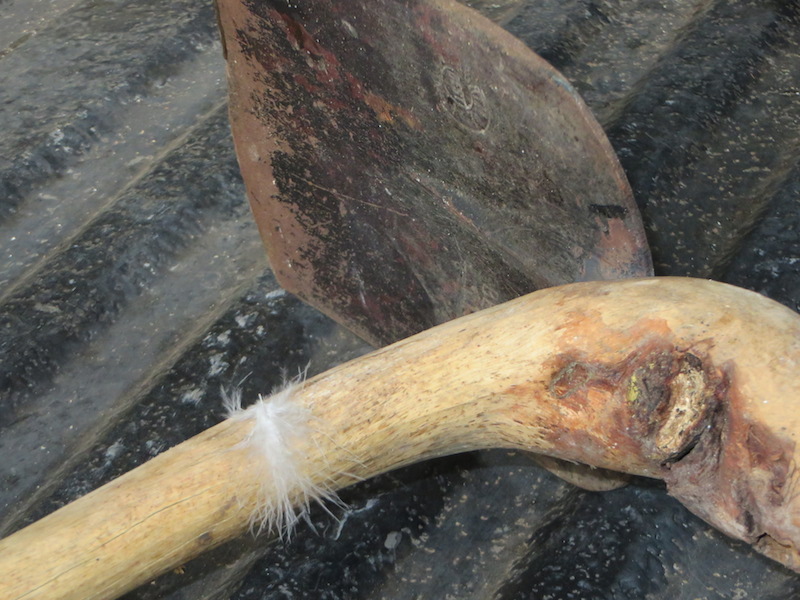
a khazu (hoe)?
This is going to be an interesting afternoon...  I went home to change clothes for the party!


When I returned, Sister Banda had just arrived, sister-in-law to Chisomo.

Look at her dress!  Okay, I am envious...
Sister Monjeza, mother of Amos
Charles Monjeza, his brother

Then a large group of women from Chilobwe arrived, obviously having arranged transport.   They sat on the bride's side and it didn't take long for them to get in the mood, since the DJ had the music going.


I couldn't help myself!

Some of the people attending


 Thoko and her sister

President and Sister Mwale above.
President Chinyumba, to the left, along with Gabriel Chinomwe and President Amos of the Ndirande branch.


with Sister Lungu


And because it was P-Day and Amos and Chisomo are favorite people of the missionaries..
 Sister Dlamini with friend


Sister Frimpong with friend


Elders Ooma and Slade


Elders Massey and Etiang


Elders Lemperle and Kampelya


Elders Mothlaping and Barrett


Elders Rugumayo and Allred


Memory Munthali left a few days later for a mission to Zimbabwe.  She is sitting with Sister Chikapa, decorator extraordinaire.


Khama Gangire (to the left) has been waiting for months for his South African visa to come through so he can leave on his mission.


THE OFFICIAL CHINKHOSWE BEGINS!
One of the first items of business was to select three people to collect the money and man the bank.  We weren't quite sure what that meant.  Sister Banda was one of those selected.


My favorite part was when the doors opened and in walked, or rather danced, a procession of what I might call "attendants".


Eight little girls all in matching white shirts and swingy skirts, with necklaces, hairbands, and each carrying a wooden paddle, circled round the room while keeping rhythm to the music.

The bride followed wearing a white top with a bright orange and yellow skirt.  Her "maid of honor" accompanied her.
Chisomo with Nancy Masoo, her "maid of honor".
One of the first things that Chisomo had to do was to find Amos by going through the audience on a search.  When she found him, she brought him to the front, along with his "best Man".

At last, the bride and groom are together up front.

A representative from each side of the family is called to the front.

On Chisomo's side (or the Banda side), an older uncle comes forward.


On the Monjeza side, Elliot Mkandawire, a close family friend, is called forward.


The two representatives play an important role in the chinkhoswe because they not only show how two families are coming together, but they also play the role of counsellors in the future if there are any disagreements or marital problems.

So now the dancing begins.  The MC, speaking in Chichewa, announced each new dance by calling out a category.  Then members of the group from that category dance to the front of the room, circle the couple, and throw small bills into a floor basket or at the feet of the couple, and dance their way back to their chairs.


At one point, the bride leaves with her attendants.  When she enters the room for the second time, once again following her attendants, she is wearing a dress that matches Amos shirt.


The dancing continues!


The money is taken to the bank, where it is counted.  Others line up to exchange their big bills for the smaller ones at the bank.  So the money get recirculated over and over.


The attendants come out, bearing dinners of chicken and rice, caggage salad.  Attendees are encouraged to bid on the dinners and in some cases, people's names are called out to come and pay for them.

The hours of music and dancing passed.  The MC called the two family representatives up to the front of the room.  First of all, they shared a cooked chicken that was brought out for them to eat.
  THEN...
For the groom's side, Brother Mkandawire carried a rooster and for the bride's side, her uncle held a chicken. 
Then they exchanged their birds!


Once the exchange was over, everyone watched...

while members from both sides brought out traditional gifts for the home the couple would create together.


A container, a whisk broom, a mat, a reed broom,


 a large basket,


a khazu and other tools.


It was beginning to get dark, and the chinkhoswe was beginning to wind down.

Clearly, some of the attendants are saying enough is enough 

A big thank you to the DJ, Lyford Ngwira, who never stopped for hours.


and I'm hungry!
The last photos are taken 


and as the final guests are leaving, the takedown begins.


As is usually the case, it is much easier to take things down than put them up!


The bank closes up shop after counting up all the money.
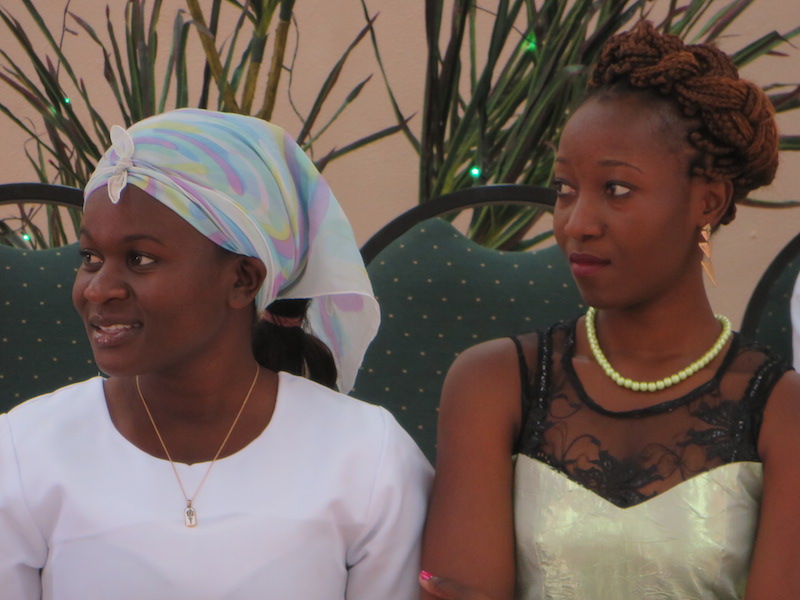
Children are happy but tired after such an afternoon of celebrating.

So the chinkhoswe is over and Amos and Chisomo, after spending a glorious day together, go back to their respective homes.  
This chinkhoswe will be an engagement party, not the traditional marriage, as is the case with some tribes depending on the region of Malawi.  
Amos and Chisomo will be having a church wedding, probably in November, and everyone can celebrate again!