Sunday, January 11, 2015

Living Water--George's Post


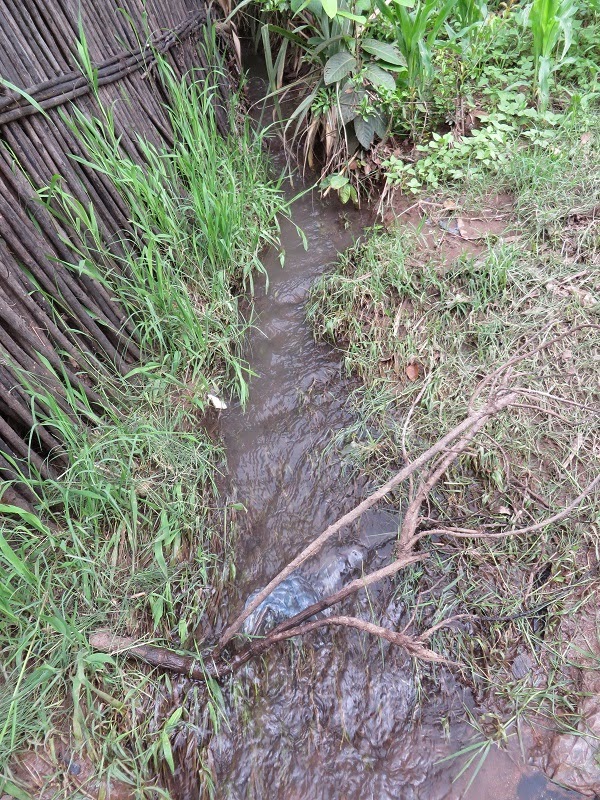
Many in Blantyre draw water directly from small creeks and streams, city water not commonly available in many townships and private wells (bore holes) too expensive for all but the wealthy.  The water so drawn is used for bathing, washing clothes, and drinking.  Apart from the inconvenience, sourcing water in this way would not be problematic, if the water were clean.  Yet, like many third world countries, domestic water sources are often contaminated.    This leads to enormous health concerns, as many Malawians suffer from water borne illnesses due to the dirty water.  Many the NGOs and Church groups active in Blantyre are working to address the shortage of clean water by drilling wells and installing pumping equipment.
The first pictures are of the springs high on Mount Soche providing the water  many of our members and their neighbors use:


These are not alpine springs flowing directly from underground  waterways and chasms.

Not surprisingly, the water gets dirtier as it flows downstream and gets closer to town.


As you can see from the next two photos, the pollution problems become more acute the closer the water gets to the townships:
 
 
We expect people generally boil the water before drinking it, but do not adhere to the same sanitary precautions when the water is used for washing, laundry and other purposes.

It was against this backdrop that I recently re-read the fourth chapter of John, when Jesus meets the Samarian woman at the well.  Thirsty, Jesus asks of the woman a drink of water.   She is startled by the request, for the Jews were disdainful of the Samarians and avoided contact  with them.   Jesus then offers up his idiomatic reply: “If thou knewest the gift of God, and who it is that saith to thee, Give me to drink; thou wouldest have asked of him, and he would have given thee living water.” (John 4: 10)  Like each of us, Jesus needed water; it was the source of life.  The well in Samarian likely produced water as sandy and dirty as the spring atop Mount Soche.  But nonetheless, that water was vital to sustaining life and restoring those parched with thirst.  Jesus was not contemptuous of that.  The body has its own demands that cannot be ignored.  There is however a greater need—the need for the word of God—for that which gives eternal life.   “Whosoever drinketh of this water shall thirst again: But whosoever drinketh of the water that I shall give him shall never thirst; but the water that I shall give him shall be in him a well of water springing up into everlasting life.”  (John 4: 13-14)


One sees here an echo of Jesus’s reply to Satan when first tempted after forty days and nights of fasting.   “And when he had fasted forty days and forty nights, he was afterward a hungred.  And when the tempter came to him, he said, If thou be the Son of God, command that these stones be made bread.  But he answered and said, it is written, Man shall not live by bread alone, but by every word that proceedeth out of the mouth of God.” (Matt 4: 2-4)  In an impoverished country like Malawi, the needs of the body appear, at times, to overwhelm everything else.  Many of those we meet are struggling to earn their daily bread; not surprisingly they focus upon the here and now; upon getting piecework to support their families; upon finding whatever edge they can to get ahead.   Dishonesty and petty theft are a way of life among almost everyone.  They see us, and indeed all westerners, as a potential source of money and aid.   And while charity is certainly a part of our calling, it is really charity of a kind different than they expect—indeed, charity different than what they want and what they think they need.  It is the full commitment of ourselves--the giving of our "heart, mind, might and strength"--to them and their welfare in such a way as to encourage or lead them to embrace the word of God.   Whatever else we give will have little lasting effect.   

In the “bread of life” passages of John 6, those of the House of Israel Jesus taught spoke of their fathers: “Our fathers did eat manna in the desert: as it is written, He gave them bread from heaven to eat.”  (John 6: 31)  But, while that bread was indeed necessary for sustaining the body, it was alone not enough.  “Your fathers did eat manna in the wilderness, and are dead.  This is the bread which cometh down from heaven, that a man may eat thereof, and not die.  I am the living bread….” (John 6: 50-51)  One cannot despise the bread of the body.  Without it life is not possible.   But in the end, only the true “word of God”-- the principles of the restored gospel—give eternal life, supplying the “living water” or the “bread of life.”


Hamelin's Pied Piper--George's Post


When Carole and I are out and about, children frequently cry out “azungu” to get our attention, sometimes from close at hand, but occasionally from great distances.   We usually acknowledge their cries by responding with “bo,” meaning “hi,” which is the customary greeting of children and young folks, or by signaling a “thumbs” up or by the wave of a hand.   There is, for example, one cluster of small kids, none probably older than five, who live across the ravine from the Zingwangwa meetinghouse, close to a 100 hundreds away.  Whenever they spot us making our way to the Church, their chants of “azungu” ring out loud and clear, and they keep yelling until we respond.  For some it is clearly a game—they score points with their buddies if they can get from us an awkward reaction; for others an opportunity to try out or showcase a few phrases in English; and for yet others a source of amusement or brief diversion from the day’s routine. 
 
These beauties we met not far for the "Living Waters Church" (an evangelical congregation).


For the most part we try to be good sports, wanting to create a good impression for the Church, and knowing that, wherever we go, we are constantly being observed.  People are always about, so these little exchanges are not just between us, but are frequently played out on a wider stage populated with neighbors, vendors and other bystanders.   There’s no harm, even if they are mocking us—our pride can survive a few jabs from kids.  But we usually find their attention to be good natured and focused upon us without malice.  If the kids are close at hand, we usually have a quick exchange.  The bolder ones will politely offer “how are you?”  The shy ones are mute and cling to the back of the little packs, are skittish, and bolt when we approach.   On occasion I will ask if I may take their picture, speaking slowly with the absurd notion that slow speech will actually help them understand, while at the same time pantomiming the “taking of a photo.”  Kids, even the reserved ones, are usually open to being photographed.  Once I snap their shot, I toggle to the “photo” display mode, so that they can see themselves.  This invariably elicits a giggle or excitement.   The older kids can understand some basic English, starting English classes in Standard 5, the equivalent of our fifth grade, while the younger ones are only able to yell basic greetings.  Chichewa is spoken in most homes, so English definitely qualifies as a second language for Malawai educated children.


Our encounters with these marauding packs of kids, most often knotted in groups of two to five, are fluid, brief and haphazard.  They last only long enough to exchange the most basic of greetings, a few hand signals or a wave, and sometimes a photo.  Then we are gone, moving on to our next appointment, the kids resuming their play.  If we are in the streets for an hour or so, something which can readily happen as we try to find the homes of members not previously visited, we can easily bump into 10 to 20 groups of kids.   They find it to be an endless source of entertainment, because it is rare to find westerners (i.e., white people) trudging the backlanes of Soche, Zingwangwa and Chilobwe, certainly not tourist spots or places where one expects to encounter expats.  Rarely do the kids follow us for any distance; it is as though they are rooted to a circle around their homes and community.  They move freely within that space, but are not inclined to venture much outside of it.   Most likely they simply lose interest after a few minutes, and can’t see the point of keeping us company, not knowing our destination, and knowing that, sooner or later, we are going to move on, far beyond the boundaries of their neighborhoods, because we certainly don’t belong where they live.  To them, we are passing through, something temporary and elusive.  Our foreignness could not be more dramatically displayed --white skinned, dressed in Church attire, non-Chichewa speaking, a senior couple, white haired (in my case, but not Carole’s), wearing name tags.  The smaller ones do not know we are missionaries, but the older ones somehow have figured that out. 
 
 
Some of you may recognize the three Banda kids--Comfort, Conscious and Corney.
 
In a few neighborhoods, including Soche, some kids are starting to get used to us, because of our prior visits to the homes of Branch members.  They have frequently watched us visiting the Bandas, Phiris, and Brothers Sangala and Petro, doubtlessly wondering what we are about.  Slowly we are losing our novelty and are beginning to have the familiarity of “old friends,” though we don’t yet know their names, nor know for sure where they live.   Yet as we begin trekking up the lower slopes of Mount Soche, they emerge, as though by magic, among the clusters of homes off to either side of the wandering trail. 
Almost every visit to the Bandas draws these four girls out for a quick chat.  You can see Carole disappearing in the distance.
 
This band of four we found at the local spring above the Banda's home on the way to Brother Sangala's.


It is easy for us to get lost in the higher reaches, the lanes are confusing and chaotic, and often we find ourselves walking directly in front of someone’s home or through their private yard.  It is especially difficult to find Brother Sangala’s home, first we work our way across a high ravine, at the edge of the private land, amid small fields, brick homes, outbuildings (including outhouses) unfurnished houses, piles of unused brick, clothes lines for airing laundry, and small creeks.   Each time I hope to recognize the paths to Brother Sangala, and each time I get confused.
This photo captures the "rockiness" of the way, but not how serpentine it is.
 
Friday of this past week was particularly frustrating.  I knew we are close to Brother Sangala’s, but somehow we found ourselves turned around, his home somewhere below us and off to our right—at least that’s what my sense of direction told me.  Here the paths are very rocky, the footing treacherous, and the way unclear.  Finally passing several older kids, off amusing themselves with some sort of play, we asked for directions to Mister Sangala.   At least one of the older ones understood our plight, gesturing down the hill.  Within minutes we attracted a small mob of 10 to 14 kids, our largest audience to date, following us as we painfully worked our way off the steep slope toward a lower cluster of homes.   After coming off a particularly treacherous ridge, and down a narrow path, we were forced to cross directly in front of a home with a family dog.   He was not happy with the unexpected intrusion, snapping and snarling to warn us off; but our little band of intrepid companions, with whoops and hollers, swept away his resistance and cleared the way for us, much to our relief.   After wandering for a few more minutes, we finally found Brother Sangala’s home, only to be met with a locked door.  Before heading off of the mountain, we took a couple of photos of our companions, feeling much like the pied piper of Hamelin, but without the magic flute.
This photo below reminds me of a Richard Scarry's picture.  You should see how many children you can find in this frame.  The person is the background (with a black blouse) is one of the mothers who looked on with amusement, so she doesn't count against the total.  We are just above Brother Sangala's home when this picture is taken, his is not the home  in the photo. 


    We encountered this band of superheros when heading off Mount Soche, returning to our truck.


Monday, January 5, 2015

Reflections on a Malawian Christmas--George's Post


Slowly I am learning, many things are just not the same in Malawi and cannot be measured against Western standards.  Understanding them requires seeing the world with new eyes.  Christmas itself is a prime example, and it has taken me several days to come to grips with our experience.  Coming into the Christmas season, it was obvious that Malawians do not celebrate Christmas like we do in the United States.  Homes are not decorated with lights and Christmas trees; traditional carols are not played in stores and malls (except at Shoprite, one of the three upscale grocery stores in Blantyre, heavily catering to expats and the wealthy); Santa is unheard of.  There are no wreaths, bright lights, mistletoe, eggnog, Christmas stockings, and reindeers to celebrate the season.  We understood it was not customary to exchange gifts on Christmas day, but I suspected this was largely an economic issue.  The poor did not exchange gifts, because they couldn’t afford to do so, while those with money managed, at the very least, to have something for their children to unwrap on Christmas morning.


Christmas morning I spent a couple of hours molding into cookies the molasses cookie dough Carole had prepared in the several days before Christmas, and popping them into the oven.  Molasses cookies are one of the many traditional treats Carole  prepares for the holidays.  By late morning, we had assembled small bags of cookies for nine families, not enough cookies in any one bag to spoil a family, but just enough to let the families know we were thinking of them.  We had made no appointments; the plan was to make very short visits to these families to drop off the modest gifts.   We expected to catch most of the families at home, gathered with other family members and friends, preparing a Christmas dinner of rice or nsima and chicken.


Our expectations were only partially fulfilled.  Eight of the nine families were at home—the Ntendas, Tsegulas, Bandas, Phiris, Brother Petro, the Mtuntalis, Tellas, and Malungas.  Only Brother Sangala was not home, probably off in his home village visiting with family.   If success is measured by short visits, we were very successful.  We were back in our apartment within two hours.  We did not however find families preparing elaborate meals or gathering  for large family get-togethers.   Certainly there was no evidence of gift exchanges or family caroling or elaborate celebrations.  Indeed, the only way it seemed different was that family members were at home and the streets empty of the normal traffic.   When we wished the families “Merry Christmas,” many were quick to say they were indeed thankful for the birth of the Christ child.   It is easy for us to feel bad for the Malawians, knowing they are not celebrating Christmas with the bounties of life as we do at home.  But the Malawians do not feel that way.  They are thankful for whatever they have.  It is sufficient for them.

Maize Fields Everywhere--George's Post


At the onset of the wet season (this year in early December), the Malawians plant maize in whatever spare plot of land they can find.  Most fields are planted at almost exactly the same time, as though the families had been patiently waiting for a cosmic signal.  Almost overnight, women suddenly appear to prepare their fields, carefully working down the rows with their traditional hoes.  Maize seeds are embedded in carefully cultivated furrows alongside roads and ditches, in narrow ravines, in family gardens plots, in large cultivated fields, neatly terraced and tilled.  
 
Here is a small plot high on Mount Soche, located in a narrow gully, just below the government land.
'
 
Someone carved out this narrow patch alongside the road for a nice little maize field.


Even rocky slopes, barely suitable for cultivation,  are planted with maize.
 
 
No parcel goes to waste, at least this close to town, perhaps it is different in the villages and countryside where space is not at a premium.  This past Sunday, Carole and I had the opportunity to drive to Liwonde for church, a two hour car trip from Blantyre.  Almost the entire way we found maize fields, much larger than the small family plots of Blantyre, but still fields cultivated by hand.


Here in Blantyre, the topsoil is exceptionally deep, except on the steepest rocky slopes, so that the furrows are dug up to a height of 8 to 12 inches.  One site in the “Three Ways” community (so named because three ways there intersect) had topsoil close to 2 feet in depth.   My father, a farmer’s son, would have celebrated seeing such deep soil; when travelling throughout the world as a family, my father invariably commented on the depth of topsoil.  Even though I am several generations removed from the farm, I have instinctively picked up his habit, something Carole has found to be a peculiar trait in a city boy. 


The soil is warm, fertile and welcoming, easy to think here in terms of mother earth, which is full of life; the fields look capable of generating abundant yields, as long as they are not exhausted through overuse and as long as they are fertilized. 


Here is a photo of some fields just on the outskirts of Soche, located on the way to Limbe.
 

Malawians use a traditional hoe, called a “khasu,” to cultivate their fields.  Virtually every family has a khasu, and a family without one is considered to be poor.   While we have seen both men and women working the fields, women are the ones most frequently found taking on the back breaking labor.   Knees slightly bent, they patiently edge their way along, back and forth, curving up the land into neatly designed patterns of parallel rows.  The work is tiring and sweaty, especially now that the days are muggy.   Strike, strike, pause, strike, strike, pause, and so the pattern repeats itself over and over again,  as they slowly prepare the field.  Progress is almost imperceptible, but after a couple of hours, the furrows emerge.  My father occasionally spoke of hoeing sugar beet fields in Garland, Utah, where he lived as a young lad.  He remembered the rows being endless and the work back-breaking and thankless.  It was in those fields, at the age of 15, he vowed never to be a farmer.  He found the work too hard.  Malawians in town do not have this experience, because their plots are so small.  Rarely does one find a field so large that it cannot be prepared for planting after a morning or afternoon’s hoeing.  These are garden-size plots, not the commercial scale farms of the western United States.  The fields in and between the villages are much larger, but even there the villagers and small farmers do not use mechanized farm equipment.


I am so intrigued with a “khasu” that, the other day, I purchased one at the local central market for 1,500 kwacha or $3.  The khasu has a narrow wooden handle, roughly 3 feet in length, with a large flat metal blade, 6 inches in width, inserted at the weighted end. 
 
Here is a picture of my khasu, propped up against a wall in our apartment.


Due to its length, hoeing is always done with slightly bent knees.  In the northern districts of Malawi, the farmers, we are told, use a similar hoe except that its handle is closer to 5 to 6 feet in length.  [Apparently, this hoe also has a different name in Chichewa, which I don’t recall.]  The use of this longer tool allows the farmer to stand upright when hoeing.  Brother Tsegula, when asked to explain the reasons for the difference, supplied this explanation.  Those living in the north are descendants of warrior-dominated tribes.  Never wanting to work with their heads down, leaving them potentially defenseless, they insisted on longer handles.  This makes for a wonderful story, but I wonder if it is true.  I have seen western-style hoes in several stores, but never one used by Malawians, either because of their expense or because the traditional hoes are preferred.
 
 
My khasu is nicely balanced—when held at the handle’s top, it swings lightly in the hand.  It is easy to see it would be ideal for hoeing and weeding.  All of the khasus in Blantyre have blades of roughly the same width.  If they have others with narrower blades—better suited for weeding, they have yet to make an appearance.  Having a khasu in the home makes me feel more a part of Malawi; tourists don’t buy khasus, why would they.  I know, however, the experience is not truly genuine—I have no field to till and tend.  Sometime in the next several weeks, I hope to find an opportunity to use my “khasu,” not to prepare the furrows—because it will be too late for that—but instead to weed.  Most Church members have small plots planted with maize, so they will certainly let me try my hand weeding.  They will, I have no doubt, find this odd or amusing.  What exactly does Elder Beal think he is doing?  But with as much rain as we are now getting, keeping their fields free of weeds will be constant battle.
Here is a picture of Brother Petro working in his maize field.
 
As you can see, I look pretty silly holding my newly-acquired khasu..


Getting my “khasu” back to Seattle will be a challenge, but, because it is so emblematic of Malawian life, I am anxious to see if there isn’t some cheap way to ship it home when we finish up with our mission.  I would love to display the “khasu” in my office at home, a constant reminder of our time in Malawi.


 The “khasu” in many respects epitomizes how Malawians, at least those living in the Soche/Zingwangwa area, provide basic food for themselves and their families.  At least in part, their life is still rooted in the past.  Many use simple, basic tools—indeed, tools of a type used by their ancestors for at least several generations—to produce crops.  Much of the agriculture in Malawi is done on a sustenance basis—through small garden plots cultivated and maintained by families for their own use.  Other than a few large tea plantations, most of the farming we have seen has been done on a small scale.  While there certainly must be some large-scale farm operations employing modern equipment, we have yet to see them.  Instead, the farming is done by individuals and families without the benefit of tractors, trucks, combines, harrows or other types of mechanized equipment.   Most fields are so small and irregularly shaped that the use of such equipment would be unnecessary and indeed not even possible.   We have also been told that even the large fields of maize are usually done by hand. 


The families hope to grow enough maize to supply their own needs and to generate a little excess that can then be exchanged for other crops, such as tomatoes, mangos, potatoes, and greens, chickens, and thin dried fish, all items readily available at the small stands found throughout the townships.   Sometimes it seems as though every other home has erected a rickety stand to peddle something to the neighbors in hopes of earning a few extra kwacha.    The stands frequently are left unattended, the wares for trade or sale simply left spread out in small heaps for display on a piece of plywood, but if anyone shows interest, with a few minutes a mom or child will appear to complete the transaction.   These small businesses are located outside of the local markets, close to and among the clustered homes, and rely upon proximity to give them their primary competitive advantage. 


At least here in Blantyre, maize is the crop of choice.  On occasion, pumpkins, beans and other crops we cannot identify are interspersed among the maize plants, but still the primary crop is maize.  Malawians expect to get one crop of maize during the rainy season.  Given the mild climate, a second crop is possible but only if the land is irrigated. 


Each neighborhood or community has its own maize mill, to which the women carry, throughout the year as needed, enormous bags of maize kernels for milling into flour.   And it is from this maize flour (white cornmeal) the families prepare “nsima” or “nhsima,” the staple food dish of Malawi and Zambia.  Nsima is usually eaten with two side dishes—one a protein side dish of meat, chicken, fish, groundnuts (peanuts) or beans, and the other a vegetable side dish of  cabbage or leaves of rape, mustard, or pumpkins.  Nsima is of a sticky consistency, easily rolled into balls, like sticky rice.  Malawians eat nsima bare handed.  Surprisingly, we have yet to sample nsima, but we expect to have it served to us sometime in the near future.  [We have been careful about eating in the homes of members, knowing how easily we could get sick drinking the water and eating the foods they routinely take.]


Saturday, January 3, 2015

Ngumbi - Carole's Post

Every morning I wake up to the "call" of the Turaco, one of the hundreds of birds that make Malawi a "birdwatcher's paradise".  In the course of our walking during the day, we frequently see vibrantly colored lizards basking in the sun or scurrying about.  We have monkeys in the nearby trees and often see young boys out with their homemade spears or monkey catchers trying to track them down.  There is no doubt that we are in exotic territory with the abundance of wildlife unfamiliar to us. However, there is one level of that "wildlife" that I have no interest in at all and yet we have to live with day in and day out and that would be INSECTS.

Just tonight we had to take our bed apart piece by piece because we knew a cockroach had eluded us by burrowing into the bedding.  We caught him and can go to bed, under the mosquito net, in peace.  
On a daily basis, we are surrounded by flies when we go out. I have learned NEVER to wear lotion or perfume because that makes me extremely popular with the black fly.  Today, knowing that I would be working with a new Primary teacher in her home, I generously applied repellent.  Sure enough, as we slowly prepared a lesson for her to give on Sunday, she had flies on her everywhere and I was spared.

To give you an example....
 These photos were taken in  the meetinghouse mid-week.

I won't even write about the mosquito because we do what we can, but it's just part of the African experience!  Nor will I write about spiders, centipedes, etc.  Another time, perhaps...

However, one of our most amazing experiences was seeing the "ngumbi" for the first time!  We were sitting in the chapel of the nice Blantyre building one evening mid December.  That day the heavens had opened and we experienced the first hard rain of the season.  It had been hot so the outside door into the foyer was open as were many windows.  As it got dark outside and it was light inside, the chapel began to fill with flying insects, with about a two inch wingspan.  I was mesmerized and could hardly believe what I was seeing. There were thousands of them!  The Malawians in the meeting didn't seem fazed at all.  After the meeting, they told us they were flying termites, also known as white ants, and how excited everyone was because they were delicious!

On the Monday before Christmas, we had a Christmas celebration for all of the missionaries in Malawi which meant we had a dinner for 52 people at the Blantyre meetinghouse. Once again, the rains came that day and as it began to get dark outside and we were starting the clean-up, the flying termites invaded our party!

 Look who is on kitchen duty!  If you look hard, you can see them flying above, especially around the lights.  You don't have to look hard to see them on the counters, the stove, the tables, the floors!  
 Also, they were in the sink, in the dishcloths - yuk!
I opened my purse and two flew out!
 George refused to open his mouth and had he not been wearing glasses, he might have closed his eyes!  This picture does not do the experience justice - they were swarming everywhere!
 I was sweeping the hallways but they were falling down as fast as I could sweep them up!
The flying termites live in cone-shaped mounds, large ones in the country and smaller ones around Blantyre.  When the hards rains come, it stirs them up and they emerge out of their mounds in hordes.

 I must admit, when I first saw them I immediately thought about the 8th plague of Egypt in the Old Testament.  Later I thought about the crickets in 1848 Utah and it seemed very real to me.
I asked Christopher, a Malawian returned missionary, about the "ngumbi". Christopher is very knowledgable about food and had prepared much of the meal.  He is studying hospitality at the local college and is number one in his class of 60.  
I knew that "ngumbi" was not so much a delicacy but that it was popular as a snack and as a source of protein.  "How do you fix them?" I asked.  He said that you could roast them in the oven till crisp or you could boil them in water until tender, then drain the water and add margarine, and continue cooking in the hot pan till crispy.  Salt liberally!

Now, the big question is "what do they taste like?" Christopher assured me that they were delicious, then brightened and said "Have you eaten locusts?"  
"Mmmm, no."
"How about grasshoppers?"  
"No."
"Then I just don't know how to describe it."

I had some members tell me that if you get the small ones, you don't have to cook them. Just pull off the wings and pop them in your mouth.  More fun for kids that way!

Two days later we headed to the market.

At the entrance to the food section of the market, some women were selling a new item

I should say a new seasonal food...NGUMBI

They even offered to give us azungu (white people) a sample.  

I declined very politely.

Of course, some ngumbi are better than others.  Since those little wings apparently aren't part of the snack, they can be sifted out or shaken until the wings separate from the body.
So the wet season begins with a cry of "ngumbi".  It won't be the seagulls scooping up these "little fliers" but rather many happy children - and the adults too.  I haven't met a mzungu missionary who has tried them yet!