Monday, August 24, 2015

Our Common Experience--George's Post


A.   Our Common Experience

1.    “There am I in the midst of Them”

In many ways we find Malawi strange.  Yet the first Sacrament Meeting we attended in the Zingwangwa Branch, after arriving in Malawi, reminded Carole and me of a fundamental gospel truth.   The setting was unlike anything either of us had ever experienced.  The branch meets in a modest sized home, located across from the “dead” truck, and is accessed by a steep staircase, with stairs of uneven depth, making it treacherous to enter the building, especially for the elderly, sight impaired and children.  When it is rainy, everyone tracks red mud into the building, smearing the tile floors, generally making a mess of everything.  The two adjoining rooms used for the Sacrament service are too small to accommodate the entire membership—so each Sunday there are two Sacrament Meetings, one at 8:00 a.m. and the other at 11:00 a.m.  The meetinghouse is a far cry from the spacious, clean, tidy, comfortable buildings used in the United States, many built using the same or virtually same architectural plans.  We were surrounded by our new Malawian members and apart from a pair of young Westerner missionaries, we were the only “azungu”s (whites) in the room.  But as soon as the members began singing familiar Church hymns, we instantly felt at home, a sensation that intensified throughout the service.  Though in a foreign land, miles from home and family, and though among people quite unlike ourselves, we took comfort from the affinity we felt to those around us, feeling the same Spirit we would feel week in and week out when attending church in our home ward in Seattle, Washington.  The differences--in venue, appearance, and surroundings--were suddenly of little consequence.  What we sensed were the similarities. 
As Church members know, this experience is not unique.  To the contrary, it is an experience, replicated each Sunday around the world, as travelling members meet in chapels, rented halls, or even homes, with local members gathered together for Sunday services in the far flung corners of the world.  It brought to mind for me the divine promise found in Matthew 18:20—”For where two or three are gathered together in my name, there am I in the midst of them.” 

2.    ”Participants in the Same Spirit”

The Apostle Paul touches upon the reasons why members, though having diverse gifts and coming from different backgrounds—find unity in the Church.  “For by one Spirit are we all baptized into one body, whether we be Jews or Gentiles, whether we be bond or free; and have been all made to drink into one Spirit.”  1 Cor. 12:  When visiting with members in their homes, Carole and I have often shared this scripture, speaking to the “commonalty” we have as members of the Church.  There are certainly many differences between us and those we visit—different language, different skin color, different educational systems, different birth places.  The differences are in fact endless.  But at one point, we are all the “same”—each of us has been touched by the Spirit and have become “members” of the same body. 
This commonalty we sense during fast and testimony meetings, when singing together the well-beloved hymns, as heart felt prayers are expressed, and when hearing the conversion stories of our new members.  It is the spirit we feel when welcomed into their homes, when sharing testimonies, in the greetings given each Sabbath morning. 
The Lord explains how it is that individuals learn and share spiritual truths.  He does this in the context of the preaching of the gospel, but the message is equally applicable when members meet together and share feelings about the restored gospel.  There is one way, and only one way, in which spiritual truth is conveyed from one person to another.  “Wherefore, I the Lord ask you this question—unto what were ye ordained?  To preach my gospel by the Spirit, even the Comforter which was sent forth to teach the truth.”  D&C 50:13-14.  “Therefore, why is it that ye cannot understand and know, that he that received the word by the Spirit of truth receiveth it as it was preached by the Spirit of truth.  Wherefore, he that preacheth and he that receiveth, understand one another, and both are edified and rejoice together.”  D&C 50:21-22.   This commonalty transcends all of the superficial differences and through it we feel our kinship of all men--all children of a loving Heavenly Father, and “brothers and sisters.”  Whatever differences there may be are all swallowed up in this supernal truth.   

Friday, August 21, 2015

Some Thoughts About Shadow Leadership--George's Post


Some Thoughts About Shadow Leadership


1.    Senior Couples Are Not in the Chain of Priesthood Authority

For the most part, a senior elder called to serve as an “MLS” missionary is not in the line of Priesthood authority.  He is not asked to serve as a district or branch president, or an elders quorum president, or a seminary or institute teacher—or, in short, to hold any position of authority to which others are expected or asked to give deference or from whom members are expected to take counsel.  Instead, the MLS senior elder, and his wife, are asked by the Mission President, to whom they directly report and to whom they are ultimately accountable, to support existing “authorized” leaders of the local church units, whether they be established wards or new or struggling branches.[1]  Senior elders have no authority or mandate to step in and assume responsibility for branch operations, such as conducting meetings, setting agendas, calling others to church positions, asking members to make commitments or be accountable.  Instead, they are to work with, support, encourage, and guide local leaders, who have been called to those positions of authority and who are, by virtue of those callings, given the authority to preside.  The role of the senior missionaries is largely ill-defined, fluid and outside of the customary chain of authority and formal organization.  They do not operate within the traditional priesthood hierarchy, with authority over the Church leaders with whom they labor, but instead stand, as it were, off-to-the-side, in an advisory or consulting role. 

2.    Desire of Local Leaders to Be Independent

The local leaders in Blantyre are well aware of the senior missionaries’ church experience and their willingness and availability to serve, but they are also mindful that the senior missionaries are not in the chain of priesthood authority.   In our experience, the local leaders generally understand the sacred callings to which they have been called and appreciate the order of the Church.  They understand the priesthood keys have been conferred upon them empowering them, subject to the oversight of those in the Church hierarchy, to govern the local affairs of the Church.  With few exceptions, they are anxious to stand on their own feet without relying too much upon senior missionaries for support.  They are equally desirous that the local members of the Church be independent. 
This sentiment is widely held and frequently expressed within the local congregations.  Several months ago, during a Fast and Testimony Meeting, President Chikapa, speaking of personal testimonies, stated without hesitation that neither he nor the branch members could or should rely upon the Beals as a senior couple or the younger missionaries, for their testimonies.  They needed to be converted on their own; they needed to have their own testimonies; they should not look to the senior couples or others for help.  The local Church must grow on the backs of the local members.  Certainly this is the right answer—as similar comments have been made repeatedly by the General Authorities when speaking of the Church membership at large.  Each members must be self-sustaining.  In a similar vein, this past Tuesday evening, the physical facilities director for Zambia and Malawi, when meeting with the branch presidents and branch physical facility representatives, reminded those in attendance that they should not look to the senior couples to stay on top of maintenance issues in the local buildings.  It was the responsibility of the local members to do their duties.  The time might surely come when there were no senior couples around.
On occasion, local leaders may be quick to abdicate their responsibility in favor of more experienced senior missionaries.  Sometimes this occurs because they lack confidence or have yet to grasp fully the scope of their callings.  They may not have been trained and feel embarrassed or ill-equipped to discharge their responsibility.  How can they perform their callings when they don’t know what to do?  On occasion, they are uncomfortable exercising their authority in front of those who they suspect to have much more experience or possess greater skills.  Even worse, they may have been burned in the past, when senior missionaries were quick to take over, whenever they felt local members were struggling to find their way.  What is easiest is to step aside and let the senior missionaries take over.  But whatever the reason, whenever this occurs, senior missionaries do the Church a great disservice by stepping in the breach and assuming the role of the called leader, for doing so undermines the authority of the local members, deprives them of growth opportunities, and upsets the divine order of the Church.  Those who have been called to serve are those entitled to the promptings of the Spirit.  It also further perpetuates the myth that leadership skills are uniquely vested in senior missionaries or those with the most experience in the Church.

3.    Looking to Senior Missionaries for Support

Local leaders’ desire to be independent is commendable, but it does leave the senior missionaries in a somewhat peculiar position when the Church is new in an area and local members have little hands-on experience.  Under those circumstances occasions frequently arise when the new leaders and members lack the experience to conduct properly Church programs and could benefit greatly by getting advice from those more experienced.  Yet local leaders, knowing that they are the ones “called” to run the Church, and not wanting to be upstaged, may be slow to ask for assistance, even when they should.  They are sensitive to being second guessed, hate the feeling of being on trial, or don’t want to be upstaged by others with more experience.  As long as they don’t ask for help, they feel more certain of themselves and are not dependent.  Moreover, they may on occasion resent offers of external input, however well-intended or generous such gestures might be, even if they know they could use the help.    The challenge of the senior missionaries is to counterbalance this natural tendency on the part of independent, well-intended local leaders by encouraging them to look for and accept advice, without trampling upon their local authority. 

4.    Keys to Providing Support—Earn Confidence and Give Advice Privately

For these reasons, senior missionaries need to trend carefully, using a light touch when working with local members and leaders.  Ultimately, the efficacy of senior missionaries as “closet” advisors is largely dependent upon two factors: first, their ability to earn the trust and confidence of local members—so that they are willing to turn to them for advice--and second, giving advice and counsel in a constructive way that supports, and does not undermine, the authority and leadership of those who are actually called to serve.  Only if those local leaders turn, on their own initiative, to the senior couple for assistance can they play a meaningful role in helping the leaders and members. 

5.    Earning the Trust of Local Members and Leaders

There is, in my experience, no magic for earning the trust of local members.  Malawi Church members are, in this regard, no different that members throughout the Church.  They respond to those who demonstrate hard work, patience, good will, love unfeigned.  They dislike arrogance, mean spiritedness, pettiness, displays of ill-temper, condescension.  They can sense whether senior missionaries have a genuine love for the Church and the members.  I have seen senior missionaries, with varying skill sets, and with different areas of focus, all be successful.  But there should be no confusion on this point—without that trust, no senior missionary will have much success in working with Malawi members.
Earning such trust often takes time, as the local leaders come to respect the judgment of the senior missionaries.  Otherwise, there is little they can do in a formal way to help a branch or ward, other than to act as “good” Church members.  Attempts by a senior missionary to insert himself or herself into the decision-making roles of the Church, without invitation, is counterproductive and disruptive.  In this regard, their role is radically different from that of the Mission President, in those areas where the local units are branches which are organized into districts rather than stakes.  Under those circumstances, the Mission President himself is the senior or, as we say in the Church, the “presiding” authority in the area.  The Mission President is responsible, not just for missionaries working within his mission field, but is also directly responsible for all units within that area that do not belong to a formally-organized stake of the Church.  This dual responsibility—oversight over the missionaries and the existing branches—is what makes the calling of a Mission President in Zambia and Malawi so challenging.

6.    Working Behind the Scenes

On occasion, the temptation is almost overwhelming for senior missionaries to take over and run the show.  This occurs when the local members are struggling with their callings.  It is so much easier to step in the breach and assume responsibility than to take the time to work with the local members to learn their duties.  As mentioned above, the advice given not only should be asked for, it should be given in a way supportive of the local members.  Senior missionaries should not take over the responsibilities of others, even if the local members are more than willing to transfer the responsibilities.  The senior missionaries should be patient, loving, long-suffering.  And most importantly, they should be willing to train in private, giving instructions and direction, and then empowering the members to fulfill their duties publicly.  The credit for successful performance should always be given to the local members.  

7.    Two Keys to Shadow Leadership—Patience and Humility

There are at least two keys to successful shadow leadership.  No senior missionary will be effective unless the missionary is prepared to be “patient” and “long-suffering,” and is willing to stand aside, working in the “shadows,” allowing the local leader to be the one who publicly performs his or her duties.  The Apostle Paul captures both of these principles in Ephesians when he says:  “I therefore, the prisoner of the Lord, beseech you that walk worthy of the vocation wherewith ye called, With all lowliness and meekness, with longsuffering, forbearing one another in love.”  Eph. 4: 1-2.  The missionary must act with “longsuffering,” and “forbearance” with one another—because of the love the missionary has for the saints.  In addition, the missionary must act with “lowliness and meekness,” not putting his or her ego ahead of the goal of uplifting and training the local members. 

8.    Challenge of Patience

Probably the hardest lesson to learn is that of patience.  To be sure, it is painful for senior missionaries to watch local members struggling with their callings:  They know this affects not only the struggling member, but also detracts from the experience of those they are called to serve.  Hence, it is hard to watch the presiding leader who has difficulty conducting church business during Sacrament meeting, the Sunday School teacher who reads the lesson and cannot formulate for the class questions that might generate active and thoughtful discussion, the elders quorum president who fails to encourage home teaching or cannot come up with home teaching assignments, despite encouragement.  The temptation is almost overwhelming to step in for the struggling member.  Yet doing so not only undermines the confidence of local members, it also serves to undercut their credibility and authority in the eyes of others.  The message to others is clear—the local member cannot do the job, best to turn the assignment over to the more experienced senior missionary who can get things right.    
What patience and prudence require is to take the time, outside of the presence of others, to train and to guide.  But such training is much harder, takes more time and commitment, than rushing in and taking over for the member who is floundering.  And at the same time, the training builds the confidence of the member, and does so without signaling to others than the member is inexperienced, inadequate, falls short of the mark.  This allows training to occur without parading the skills of the senior couples.  In some cases, perhaps in many, the local members will never develop skills (or at least presentation skills) on par with those senior members who have decades of Church experience and may possess skills and have educational backgrounds far superior to whatever the local members might acquire.  Fortunately, the Spirit can and does make up the difference.  Often, after watching local members do their duties—conducting meetings, giving instruction, teaching lessons or giving talks—I have been left with the distinct impression that these members, though new to the Church, inexperienced, just learning their duties, have been abundantly blessed by the Spirit, such that their service was truly inspired.  I have known that I could not have done better, even with my years of experience both in the Church and in private affairs.

9.    Desire to Take Center Stage

The scriptures counsel us against pride when exercising our authority in the Church.  “Behold, there are many called, but few are chosen.  And why are they not chosen?  Because their hearts are set so much upon the things of this world, and aspire to the honors of men, that they do not learn this one lesson—That the rights of the priesthood are inseparably connected with the powers of heaven, and that the powers of heaven cannot be controlled nor handled only upon the principles of righteousness.  That they may be conferred upon us, it is true; but when we undertake …. to gratify our pride, our vain ambition, or to exercise control or dominion or compulsion upon the souls of the children of men, in any degree of unrighteousness, behold, the heavens withdraw themselves; the Spirit of the Lord is grieved; and when it is withdrawn, Amen to the priesthood or the authority of that man.”  D&C 121: 35-37.    I don’t know how many senior missionaries are affected with this malady—but at least some of them are, even if the temptation is subtle.  They would rather be “front and center” than laboring in the shadows.  They enjoy teaching Sunday School far more than they like working privately with a struggling member, helping him or her become a better teacher.  They can’t stand the bungling efforts of a local priesthood leader—far better from them to take over the class or the instruction.  They want the local members and leaders to know of the success of their missionary efforts rather than leaving the credit to others. 


[1] What is true for the priesthood bearer is equally true for his wife, who also operates outside of traditional lines of authority.  Rarely will she serve as a primary or relief society president, at either the branch or district level, but will be asked to “train” or “help” the presidents then in place.

Maize is Life (chimanga ndi moyo) - Carole's Post

Maize, the staple crop of Malawi, was actually introduced to Africa in the 1500's by the Portuguese, who brought it back from the New World. After all, Malawi is right next door to Mozambique which was colonized by the Portuguese.   Whereas in industrialized countries, maize is mostly grown for livestock feed, in sub-Saharan Africa, more than 300 million people depend on it as their main food source. 

In Malawi, 84% of the population lives in rural areas where the majority are engaged in subsistence farming.  Even in the cities such as Blantyre where we live, you can see that many landowners and renters plant maize on small plots or steep hillsides next to their homes.  Most people have ties to a village and they might go back a couple of times a year to participate in the planting and harvesting of maize on their family land.

I have been fascinated watching the entire cycle of maize production.  The fields are prepared in late fall, in anticipation of the rainy season and usually they will not plant until after the first rainfall.

They have told me that they alternate the furrows each year so as not to plant in exactly the same row. 


Last year the rains were late as they said they were the year before.  Maize is very susceptible to drought so farmers and city people were worried.  Eventually, maize was all planted by mid-December.
Within days, we saw the pretty little shoots.


These fields are actually in the city, just high up on Manja.  They do not seem to be as well maintained (weeds!) as the smaller plots down by the houses.
Within two weeks, the plots are usually weeded and fertilized. However, for those families that cannot afford fertilizer, the yield is substantially less.
As we walked around town, we could see the maize growing taller almost before our eyes.
In this case, the maize has been planted along with beans.


We even had maize growing in the backyard of the Zingwangwa meetinghouse.

 By about April, it is time to harvest the maize.
There are vendors all along the roads who are happy to sell you roasted corn.  It looks delicious, but is not the sweet, soft corn that we are used to in the United States.  It is not sweet, not soft, and it does not come with butter and salt!  But it is obviously a treat for the Malawians!

Mostly, the corn is picked and the cobs of maize are left out to dry in the sun.

When the cobs have dried for several days or a week, a big family project begins.  This can actually be a great social occasion because everyone is working to extract all the kernels of corn.

While we were waiting for someone in a house, the other family members showed us how to remove the kernels.  You slide your thumb along the row, flicking off the kernels on to the mat.


Suddenly, everyone wanted to participate. It's not everyday that you get to watch an azungu help with the food storage.


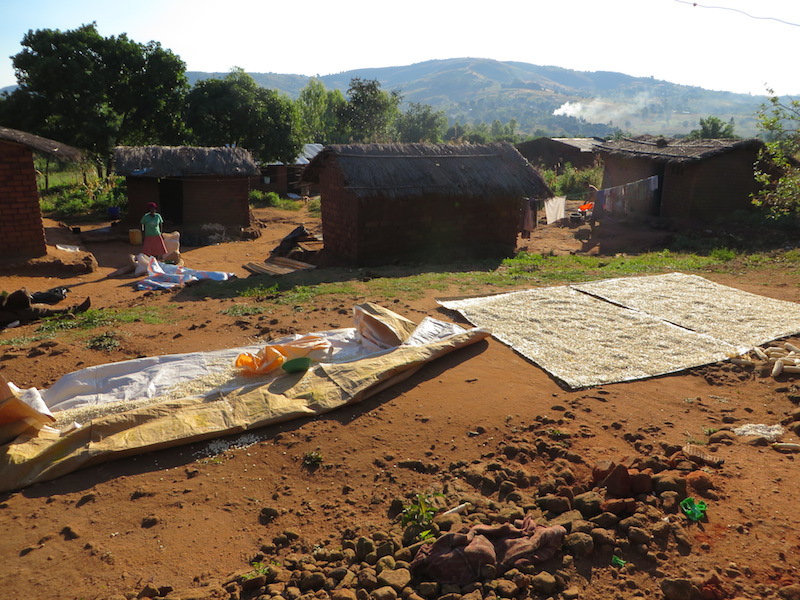
Eventually the large pile of maize kernels is left out to dry some more.


When we went to one of the villages, there were many mats of maize out to dry.


For many families, once the maize kernels are dry, thay are packed up and stored in 50 kg bag.  When it is time to use the maize, the women carry it (or a smaller portion) to the maize mill.
We ran into Sister Banda one day as she was on her way to the mill, helping a neighbor who was unable to go herself.


It seems like every neighborhood has its own maize mill.

Early in the season, when the grain is ground into a meal, it still requires another drying period before it can be stored.
So this time, the mats are filled with a maize meal.

Maize meal is finer than our corn meal, nor does it have the golden color because the African maize is white.

The maize flour is cooked into a paste to make "nsima", a thickly mashed porridge that is eaten with "ndiwo", a relish of fresh greens, onions, tomatoes.  Sometimes a protein of beans or dried fish are added.

Here is a picture of nsima being prepared on a tripod of three stones.  


Preparing nsima on a tripod


and a preparation of the ndiwo at the Banda home.


I find nsima to be similar to polenta.  It does not have much taste on its own, but when combined with other flavors, it can be quite tasty.   Unlike polenta, is is eaten with one hand, usually out of one large pot.  Families wash(rinse) their hands in a communal bowl before and after the meal.

This year the crop was not so much affected by the late rains. Rather, it was devastated by the flooding in January, particularly in the south.  Houses were washed away, but houses can be rebuilt.  It was too late to replant the maize for this years harvest.  Consequently, we are getting to the difficult months when families are running out of the grain.   
ADMARK (Agricultural Development and Marketing Corporation) is a government entity that buys and stores maize (and fertilizer) in order that the prices will not be jacked up in times of famine.  We see ADMARK offices and silos as we drive about in the country.  It is now illegal to sell Malawi maize or maize products outside of the country.  
The last major famine was 2002 when the death estimates were between 300 and 3000 but we certainly hope the government is now better prepared to deal with the oncoming crisis.  

Sunday, August 16, 2015

Malawian Seasons - Carole's Post

I am so confused.  It is August but it is just starting to get really warm.  We are not heading into a fall harvest season as I know it because the harvest is long past.  Living below the equator is confusing enough.  When we were visiting in Lilongwe last week and I was having trouble with the faucets, Sister Birrell reminded me that the cold side was hot and the hot side cold. "Remember", she said, "we are below the equator and everything is backwards!"

It is easy to lose track of which month we are in.   When I mention summer or winter to Malawians, they are not quite sure what is meant.  In Malawi, there are three seasons:

Cool season:    May to mid-August
In Blantyre, we have seen people bundled up in parkas and scarves.  But for us, it usually just means we need a sweater in the evenings and occasionally during the day.
                          
Hot season:      mid-August to November
We arrived at the beginning of November 2014 and found the weather to be lovely (after all, we are coming from Seattle). It was hot but not too hot.  It was definitely dusty.

Rainy season:  November to April
Except for an occasional bad storm, it usually just rains a brief time during the day.  People take cover and then it's over and the day is warm and slightly humid.

What I really love is seeing the rhythms of life and there are two very distinct seasons for the important elements of life: food and shelter.  Right now we are in the brick making and building season.

In many of the neighborhoods where we spend our time, people are busy making bricks.  Big holes are left where they have been busy digging out the clay and soil.  After wetting the clay, they put it in molds, then push it out to dry in the sun.


We have noticed distinct differences in the bricks, but our uninformed eyes cannot always tell if the differences are in the soil, or the molds, or the care with which they are made. 

Bricks seems to be produced everywhere except in the very nicest neighborhoods.  Sometimes people make them not for themselves, but to sell to neighbors.  It is more cost effective to buy bricks close to your building site than it is to go find a better price elsewhere, because there is no way to transport them.

In fact, there are not too many places we walk that we do NOT see the manufacture of or piles of bricks.


I know I have written before about "burnt" (fired) and plain bricks.  There are frequently ovens (kilns) next to the brick piles.


When they get a fire going, they try to keep it going for about three days.


We went to visit one family in the Zingwangwa branch who was making bricks to rebuild a storm that had collapsed in the January storm. They were not "burning the bricks" because they did not have enough money to buy the wood for fuel.

There is an obvious difference between the fired and unfired bricks.
Brother Tella (holding Amulek) has a nice collection of bricks because he is adding on a room.
These bricks are for sale.

With the making of the bricks come the building and repairing of houses.  There are a few more months before the rains come so people are busy making their shelters secure before November.

Wednesday, August 12, 2015

Punctuality--Order and Exactness--George's Post


1.    Punctuality--Order and Exactness

The Mormon Church operates in an orderly way and expects its members to follow Church practices and protocols with a measure of exactness.  Our experience in Malawi underscores the importance of emphasizing such exactness.  Malawians are notoriously late for meetings, appointments, and commitments, the more important the individual the more egregious the conduct.[1]  Being late, and forcing others to wait for you, is a measure of one’s prestige.  Important people don’t have to worry about the schedules of others less important.  Not surprisingly this lack of punctuality has been carried over to the Mormon Church.  Anyone ever attending the Mormon Church in Malawi knows what a struggle it is to start meetings on time.  Regular Church meetings frequently start 20 to 30 minutes late.  At the appointed hour, very few members are in their seats, including the leaders who are invariably late taking their places.  It is even worse for branch socials or other less formal gatherings—such as institute or seminary classes—where people may show up an hour or two after the announced beginning time.  Members arrive on a rolling basis, without a sense of urgency.  No one takes the schedule seriously.  Only after a quorum has assembled does the scheduled meeting began—and who knows when precisely that will happen.  No one appears too upset by the delays.  Time is not that big a deal.[2]
Initially I was mildly amused by this custom.[3]  Of all the things we needed to address, punctuality ranked low on the list.  Far more important was helping members appreciate the importance of modesty in dress, keeping the law of chastity, learning to be honest in their dealings, developing unity in the branch, becoming self-reliant.  It was better getting them to attend church on a regular basis than worrying about when they get there.  One can’t tackle all of the problems in a branch at the same time—choosing one’s battles is imperative for any church leader.  Emphasizing everything is the same as emphasizing nothing.  What does it matter if church meetings start late?
Several months into our mission we travelled to Lilongwe, where the Mormon Church has four units.  We were surprised to discover the two senior couples then serving there (the Fisks and Stones) had emphasized with the leaders starting church on time.  As a consequence, while meetings might start a bit late, they began only five to ten minutes after the scheduled hour. 
Inspired by the Lilongwe experience, Carole and I began encouraging, first the Zingwangwa Branch leaders, and later those in Blantyre Second, to be more “exact” in their obedience—starting Sacrament meeting on time, whether or not anyone was there.  And at the beginning that was literally the case—Sacrament meeting could begin with only ten members in the chapel.  We also stressed starting other church meetings at the scheduled hour.  Over time, we have found some improvement, though it is still the case that many members come late, many long after the sacrament has been passed.  Both branches do announcements at the end of the service to maximize the number who get the news.  
Much to my surprise this slight adjustment appears to make a big difference in the members’ attitude and the flow of the Sacrament and other meetings.  I am hard pressed to understand why this should be the case.  Yet somehow being obedient to this one seemingly trivial instruction matters.  It increases accountability, makes the meetings flow better, gives us something we can rely upon.    It is as though discipline in one “small thing” carries over to an exactness in areas far more telling.  While they may not be directly relevant, I am reminded of those scriptures speaking of the significance of “small things”  in the kingdom of God.  “Wherefore, be not weary in well-doing, for ye are laying the foundation of a great work.  And out of small things proceedeth that which is great.”  D&C 64:33.


[1] Several months ago President Matale, the area’s Public Affairs representative, invited a number of City Councilmen and village chiefs to come to the Blantyre building to talk about this year’s Helping Hands’ project.  The Deputy Major was the senior most member to attend.  Though he arrived slightly before the scheduled meeting time, when he discovered that others were not yet there, he went back out to the parking lot and sat in his car for some 30 minutes after the scheduled meeting was to start.  Then he made his appearance and we began the meeting.  
 
[2] This may, of course, be the key to understanding Malawian behavior.  Unlike Westerner countries, where most everyone is time driven, Malawians, at least those living in the poor areas where we labor, are not driven by schedules.  They have an abundance of time—they are not generally hurrying to get anywhere—so why does it matter when meetings start.  They will start when enough of the people get there and waiting around is not upsetting.  It is simply more time to socialize or another way to kill time.  Church buildings are nice, when compared to their homes, so there is nothing unpleasant about being stuck at Church.
 
[3] The longer we are in Malawi the less we tolerate tardiness in the behavior of others.  Disregard for others’ time and schedule is disrespectful and causes havoc to others’ plans and efforts to get things done in an efficient manner.  After a while we advised tradesmen and others providing us services, that if they couldn’t get there at the scheduled time not to bother coming at all.  Without such rigid rules it is really hard to get anything done.